
 +86-13634185427

What Is the Best Fabric for a Puffer Jacket? A Complete Guide to Warmth, Comfort, and Durability


What Makes a Good Fabric for a Puffer Jacket?
Key Qualities That Define an Effective Puffer Jacket Fabric
For the outer layer of a good puffer jacket the fabrics used have to meet three important criteria: warmth, durability and comfort. The outer layer of the jacket is responsible for protecting the insulation against wear and tear and thus against a loss of warmth. An important feature is the wind- and water-resistance, which enables wearers of puffer jackets to be outdoors in cold and wet weather. For physical activities, however, the outer layer of a puffer jacket has to be permeable to air in order to prevent the wearer from overheating. That means the outer layer has to allow air to penetrate without losing its protective function.
How Fabric Choice Influences Warmth and Comfort
The name of the puffer jacket fabric’s density and weave structure helps to determine whether said structure will trap heat effectively. Certain materials, such as nylon, are very dense; thus, they reduce airflow considerably and assist in keeping warm air close to the skin. Conversely, lightweight materials that assist mobility, such as cut and finished polyester microfibers, can maintain their insulating properties. A soft inner lining of polyester taffeta or nylon is also incorporated in order to ensure wearer comfort when wearing said garment for long periods of time, in order to prevent garment-to-wearer contact, which can cause irritation in itself.
Common Fabrics Used in Puffer Jackets
Nylon: Why Is It So Popular for Outer Shells?
One of the most common outer shell materials is nylon. It has the best abrasion resistance and is also one of the windproof materials. Adding a durable water-repellent coating makes it even better at repelling water and staying flexible. Its smooth surface also gives the jacket a very modern look.
Polyester: How Does It Compare to Nylon?
An incredibly affordable material, polyester is widely used within puffer jackets for sale by the yard as it’s so easy to clean and quick-drying too. This means that even when washed and subsequently worn in damp conditions, it will still keep you warm and cozy. Polyester has come a long way over the last few years, it’s far softer and more flexible than previous versions, perfect for the casual wearer who needs lightweight warmth.
Other Fabrics Found in Premium Puffers
Ripstop Fabric
Our ripstop fabrics are made with reinforced threads which prevent tearing and/or ripping even when subjected to stress. Our ripstop fabrics are ideal for outdoor use or performance clothing i.e. jackets that need to be extremely durable.
Microfiber Blends
Lightweight and soft, microfiber blends have the best moisture management characteristics. For that reason, they are very often used in so-called fashion puffers, in which a high level of comfort is not only achieved by the insulation but also by the outer material.
What About the Inner Lining and Insulation of Puffer Jackets?
Which Materials Are Commonly Used Inside Puffer Jackets?
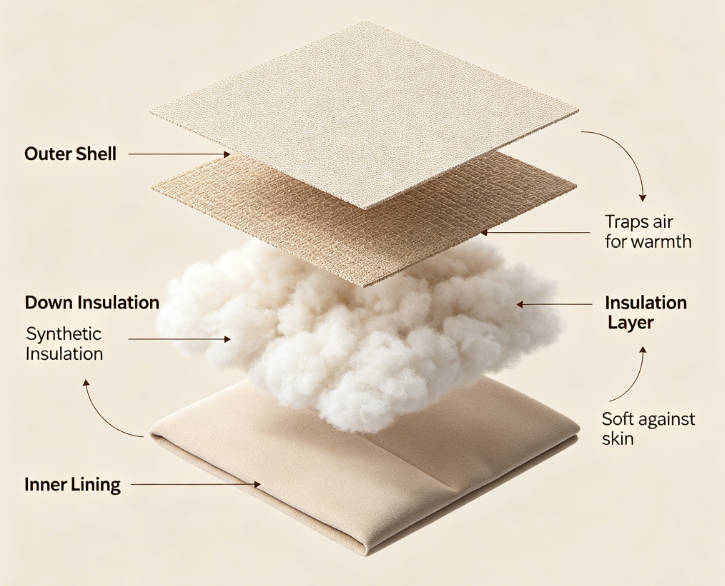
The inner lining of a jacket greatly contributes to the wearability and warmth of a product. Typically made from polyester taffeta or nylon, the smooth material enables wearers to wear the jacket on top of other layers and provides ultimate comfort against their skin. The lining for many of our products is Polyester, providing excellent softness, and the material performs consistently well across all designs.
How Does Fabric Affect Insulation Performance?
Moisture-wicking lining fabrics are designed to keep you warm by allowing moisture to escape from the body while keeping the heat in. The tight weave of the outer layer of a base layer also helps to reduce the amount of air space between layers, which can facilitate heat loss by convection. The best base layers are paired with high-performance insulation, such as down or synthetic fill, to provide warmth in a variety of conditions.
Fabric Treatments That Enhance Performance
Water Resistance and Weather Protection Features
Durable Water Repellent (DWR) treatment on outer fabrics allows rain to form beads which run off the surface of the fabric, preventing water from seeping into the fabric. Additional outer layers of Laminated membranes, such as Pacl Shell, provide increased waterproofing without losing breathability, a must for users who are dynamic.
When it comes to the fabrics and accessories of our seam-taped clothing, we conduct thorough water pressure and fastness tests upon receipt. This ensures that waterproof performance meets rigorous standards suitable for demanding outdoor applications.
Durability Enhancements Through Coatings and Finishes
Anti-abrasion finishes on clothing extend the use of areas subject to rubbing such as cuffs and shoulders. UV-resistant coatings on outerwear are designed to resist deterioration due to prolonged exposure to sunlight helping to maintain the color and performance of garments.
Choosing the Right Fabric Based on Use and Environment
Which Fabric Is Suitable for Urban Wear vs Outdoor Adventures?
For Everyday Urban Use
For the urban wearer, weight and style are the key considerations; lightweight polyester or microfiber garments offer easy care, softness, and adequate warmth without the excess bulk of heavier materials.
For Outdoor or Harsh Weather Conditions
Ripstop nylon treated with DWR provides the highest level of durability for use in windy, rainy and snowy conditions. For hiking and mountain sports, this fabric offers the best possible protection.
Factors to Consider When Buying a Puffer Jacket Based on Fabric Type
Climate is key – in dry weather, we love to wear breathable fabrics even in the middle of winter, while wet weather calls for water-repellent versions of the same. The wearer’s activity level is also a crucial factor, so if you are highly mobile, then lightweight fabrics are best, while heavier, denser weaves are more suitable for those who spend most of their time sitting around and need more warmth in one place.
INVIDIA TEXTILE Contribution to High–Performance Puffer Jacket Fabrics
Innovative Textile Solutions from INVIDIA TEXTILE
At INVIDIA TEXTILE, we are able to make nylon and polyester materials for outerwear . We provide OEM&ODM service. Our puffer jacket fabrics are very durable and also soft. We can also make fabrics that are very good at thermal regulation by making weaves precisely.
Our production facilities are equipped with the latest technology in quilting to increase the stiffness and aesthetic value of our products. INVIDIA TEXTILE offers high-quality custom coats made in Europe at factory-direct prices, enabling brands to offer premium-quality products at competitive prices. We work with a number of certified suppliers who produce puffer jacket fabric by the yard that meets the Oeko-Tex Standard 100 for safe and sustainable production.
FAQ
Q: What fabric keeps you warmest in a puffer jacket?
A: Down-proof nylon or tightly woven polyester shells paired with quality insulation trap heat efficiently while blocking wind penetration.
Q: Are puffer jacket fabrics waterproof or just water-resistant?
A: Most puffer jackets use water-resistant coatings rather than fully waterproof membranes, providing protection from light rain but not heavy downpours.
Q: How do I maintain my puffer jacket fabric for long-lasting performance?
A: Wash your item carefully with a gentle detergent. Skip fabric softeners completely. Place it in the dryer on low heat. Add a few clean tennis balls to bring back the loft. Store the item loosely in a cool dry spot.
